Poleaxed by plague

Oh, OK, it’s a bad cold. Well, one with added bronchitis and a cough that can probably be heard in Ulan Bator, but hey. I am feeling somewhat sorry for myself – especially since this week was supposedly a week off for a family visit over half term. Instead of which I have probably achieved nothing other than to give my nearest and dearest their worst colds of the winter. Nice.

But stop – I have also achieved this:

cowl

I know, it looks like small furry animal all curled up like that. Soft and fuzzy – which, according to a recent wildlife documentary, is the essence of cute. Admittedly so are big, front-facing eyes which this has not got, but – hm, maybe I’be had too much Ventolin.

It’s actually a cowl,

cowl

A double-moss-stitch moebius cowl, to be exact, and it will end up as one of my simple patterns on Ravelry (and here) eventually. It’s part of my determined effort to use up my stash, and specifically the huge amount of lovely angora mix I bought at Wonderwool ahem years ago, and which hasn’t quite found its way into a finished garment. It’s being used double, which means it knits up really quickly.

And I’ve started another variation on the theme. I was going to repeat the moss-stitch but in my current befuddled, be-Ventolined, be-Paracetamolled condition I was unable to cope with the complexities of the pattern (!). So this is a displaced rib, as it were, and I’m loving the texture:

ribbed cowl

Again, I’m using yarn from the stash and again I’m using it double. This is a Queensland DK, 100% pure Merino, very lovely. There were no dye lots, because it’s a small dye-run, totally artisan product, and they suggest you do what is, in effect, a Colinette – knit with two balls, using them alternately every two rows. Tried that: stripes. Marked stripes. My skeins are very different,

different colours of yarn

as is glaringly obvious – in this case, one brownish, one greyish. Using them double is the perfect solution, and so they have been rescued from the ‘Feck this, you’re going to a charity shop’ bin. I don’t need all these cowls (in theory), but there’s going to be a designer-makers’ fair focusing on fabric and fibre in Harlech in the summer, and they’ll make good stock. I’m hoping it won’t be the sort of summer to require 100% Merino cowls, but that people will instead buy them for Christmas.

In the meanwhile, life in this village is a bit like the ‘bring out your dead’ scene from Monty Python and the Holy Grail (and it’s not just me: someone I know said working at a nearby surgery ATM was like ‘working in a bucket of rats’). Now Monty P: that’s something I might watch. Either that or the box set of The  Nazis: A Warning from History. Not that I’m getting depressed about the forthcoming election, oh no. I’m depressed about there being another eleven weeks of pointless point-scoring and bitching and bickering and silly repetitious sound bites and spin doctors and slanted media and far too many ******** politicians. AGH!

Bring out your dead! Bring out your dead!


Loving the details

I’ve just started a new Pinterest account on which I can indulge my passion for fibre and flowers (as opposed to my business one, which is slightly diverted from the path of righteousness by wool). It’s not worth looking at yet, but as soon as it’s built up a bit I’ll make sure I share it.

I started a board called ‘knitting – details’ as it struck me how often I fail to look really closely at what I produce. Once it’s finished, that is – I scrutinise it quite finely as I work, of course. And I wanted to celebrate the sheer joy of it, instead of seeking out any dropped stitches and minor errors (the major ones soon make themselves known), so I’ve been enjoying myself with some close-ups.

First, Colinette. Point Five, I think – found in a charity shop, knitted into a jumper and then rapidly frogged when I realised I looked like the Michelin Man in it. It’s now a throw.

Colinette throw

Muted, but shot through with colour.

Not so muted:

Fair Isle

The sleeve and body of a Fair Isle cardigan, knitted in Rowan’s Cotton Glace. Love the sleeve detail, and I just take it for granted. To the extent that it sometimes comes with dried bread dough as an extra.

And now for some garter stitch:

hitchhiker

It’s a Hitchhiker, and it was knitted as a present. I’m not quite sure how I managed to give it away, I loved the colour changes so much.

Now for more mutedness (is that a word?):

mutedness

The reverse side of the cardigan I’m wearing as I type this. Maybe I should have made it up the other way round…

Finally, It’s a chilly morning. Pull up your computer, laptop, tablet or phone and warm your hands on this:

Warm

It’s Noro, of course, knitted with some Kidsilk Haze for not-entrely-superfluous extra luxury and yumminess. Actually, it’s too wide for a realistic scarf and too short for a stole and it needs reknitting, but I haven’t the heart.

So take a close look at your knitting and enjoy! (It helps if you’re supposed to be working and are looking for something more interesting to do, by the way, while the  builders next door appear to be digging to Australia so enthusiastically that it’s difficult to concentrate on anything.)

Incidentally – I’m always surprised by the number of Woolwinding images on Pinterest: thanks for sharing!

How to block your knitting (without too much mess)

Caution: this is a knitting post. In contrast to a couple of previous posts, there is absolutely nothing here about curing toothache by wrapping a sheep’s ear round your foot (or whatever unlikely combination of ailment and sheepy remedy you can invent) …

Way back when the world was young, my stash was noticeably larger (cough – it’s gone down and, cough cough cough, back up since then), and I had just started this blog*, I wrote a quick post about blocking. Both I and the blog are older now, but I am still being asked about blocking (or dressing’ or ‘finishing’), only now it’s when I’m doing my stint in the wool shop. So I’m going to risk repetition – but with a different garment and bigger pictures. And apologies if you’re a perfect blocker!

(I’m not, but my method works for me.)

Noro 1

This is part of a cardigan in Noro Silk Garden Lite that I have just finished knitting. I am currently in the process of picking up the front bands – well, I am currently in the process of picking up the front bands and swearing a lot because I’ve had to make a lot of corrections to the pattern – again. What is going on? Have people, even ‘big people’, stopped using tech editors and test knitters? Thank heavens I’m an experienced knitter, grumble, grumble…

Ahem. Blocking.

There are, I suppose four different ways to block or finish your work, and in theory the one you use should vary according to what you are doing. I generally use two of these, which I find suit almost everything. And neither involves huge amounts of disruption or the purchase of expensive kit.

shawl blockingThe first of the four is classic blocking, which has increased in popularity (or perhaps that should be prominence) relatively recently here in the UK, as it seems to be much more common in the US. It’s always been used for shawls, though, in one form or another, and often for lace work (though I’ll get onto ‘dressing’ in a mo). Essentially you wet the piece of knitting then pin it out firmly on a pad of towels and rugs (or an old mattress, or whatever), pulling it into shape until you match the measurements on the pattern schematic, and leave it to dry off. If you’re working in the round or creating a seamless garment, it’s not quite as easy (unless you use a frame – see below).

There are perfect blockers, people who do all this, who carefully damp their garment pieces, bit by bit, and pin them out to exactly the measurements of the schematic. I am not that person. I do block shawls and other lacework, but that’s because lacework looks like a pile of desiccated old cobwebs if you don’t. With a shawl, you extend the piece until the lace looks right, pinning it in the same way. You can buy blocking wires for shawls, but I tend to use a selection of glass-headed pins or T-shaped blocking pins.

(Be warned: shawl blocking will probably need redoing if you wash a piece, or just as time goes by. Some yarns are more stable than others, though. I have a Citron shawl in Malabrigo Lace that is now about half the size it was when blocked a couple of years ago – this is west Wales; we have high levels of humidity – but one of my eyelet shawls in Araucania Ranco is almost the same size.)

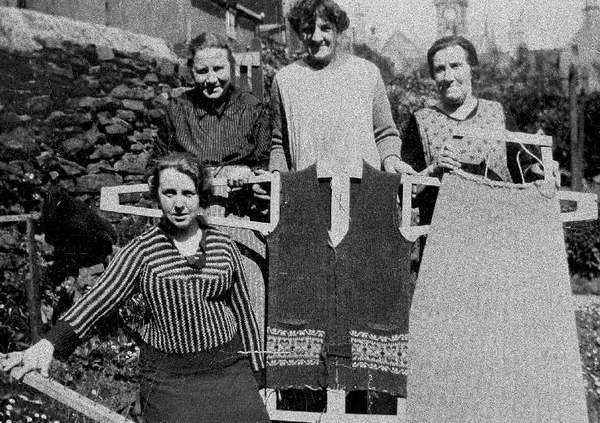
Shetland dressers

Shetland knitters with garments on dressing frames; courtesy Shetland Museum and Archives

This type of finishing shades into the second one, known as ‘dressing’, generally – though terms for this often seem to be interchangeable, and are also often very local. Fair Isle sweaters are still traditionally dressed on frames, but most of us don’t have access to these (though I’d love one, I must admit).

In places like Shetland, big hap shawls would also be stretched out on a frame, and I was given a great tip there a few years ago. ‘Use substantial cardboard cut to half the length and the full desired width of a lace scarf. Wrap board in many layers of parcel tape. Damp scarf and fold carefully in half with the card in between the halves. Tack the edges together carefully to match, gently stretching the lacework to do so, and leave to dry.’ Boom boom; it works. And sock forms, mitten forms, glove forms – all these are used for dressing smaller items.

The third type of finishing (allegedly, hah, almost finishing off) is one which no one should do because it damages the work you’ve spent ages creating, but which almost everyone has at some point. It’s standard, non steam, direct pressing and I’m still stunned by how many people have problems with their knitting because they’ve blasted it with direct, dry heat. One example I was once shown had even melted. Others have been burned, and the rest look sad and flat and lifeless. Even direct-contact steam ironing can be too much. Better is…

Four: my favourite. Steam pressing. (I’ve been known to steam small items over a kettle, but that doesn’t work for garments. Generally…)

steam pressing

Lay out the piece you need to deal with on an ironing board. Wet a tea towel or piece of calico or something of similar weight, and spread it out over part of the piece, being very careful to unroll any curled edges gently under the cloth. Carefully steam iron the cloth. Work bit by bit, moving the cloth and rewetting it as needed (I start in the middle and work out).

Don’t press too hard, don’t drag the iron over the surface hurriedly, and don’t hold the iron on any one spot for long. Oh, and don’t poke at it with the tip of the iron – quite easy to do when you’re dealing with a rolling edge. You almost need to tease the work out.

If your work is ribbed or cabled or highly textured, this technique will flatten it too much – my mother drummed into me that I should never, ever do this with a rib, and I still don’t. Deal with any curling edges in this way, but you can steam block without the cloth and with the iron held about a centimetre above the piece. I don’t seem to get the same nice finish, except on highly textured knits where steam pressing with a cloth wouldn’t be a good idea. And I don’t find it’s as effective for those edges. In those circumstances, you might also want to use classic blocking (I don’t; I need my floor space).

I realise I could have chosen something more evenly spun than Noro to demonstrate this, but here goes. The one on the left is unblocked, the one on the right is blocked.

And because that’s not 100% clear (I love Noro dearly, but even it isn’t), here are some gloves – sorry about the phantom hand, and pattern to follow, incidentally:

The contrast in the photographs isn’t as marked as it is in reality; the light is a bit difficult at the moment. I’m a huge fan of taking a bit of time to block. I can’t understand why people who don’t block or finish or dress or whatever (and there are many), don’t give it a go and see what a difference it makes. And I really, really want a sweater frame. I’m going to be back in Shetland in June…

*OK, it was only four years ago, but hey. Four years in internet terms is like, several millennia, man. I was revising my work website today and looking up what I’d done in the past when I realised I’d been one of the first people to get their publishers’ books on Amazon UK, in 1998. I went in to the studio early because I was so excited. I know, I know: life, get a….

The Strangeness of Coloured Sheep, 2

(The one without Keanu Reeves, or indeed anyone you recognise from The Strangeness of Coloured Sheep 1. Of course It needs a portentous subtitle, like ‘Return of the Wool or ‘The Wool Strikes Back’… and the more high-flown the subtitle, the worse the film. Ahem.)

Sorry about that. Time, now, for some surprising facts specifically about coloured – generally described as ‘black’ – sheep. The first is really timely, so get out into the lambing sheds.

shepherds watchingIt’s very lucky if the first lamb you see in spring is black (but what if you breed Black Welsh Mountains or Zwartbles or Ouessants? Are you always lucky? And does it work if you’re watching Lambing Live on the telly?)

Anyway, if you see a black lamb before any white ones, you should make a wish immediately. This is particularly true in Scotland, where naturally coloured wool was valued because it was used in the shepherd’s plaid. It’s absolutely not true in Shropshire; in fact, it’s the opposite: extremely unlucky if the first lamb born in a flock is black, and even more so if it’s black twins (but black twins are also bad news in Scotland). And here’s another negative one: if the black lamb is the first one, the farm will be in mourning before the season’s out.

The ‘throwback’ effect gives the occasional black sheep quite naturally, of course. This can happen in the other direction: on Ouessant, for example, where the native sheep have been bred selectively for their black fleeces, there can be the occasional white animal.

In Sussex it was a good thing to have one of these surprising black lambs in a flock – very propitious. But only one; more than that and you might as well be in Shropshire. And yet all the Mediaeval shepherds in Books of Hours with their multi-coloured flocks seem to have been extremely lucky, given that angels chose to appear to them – so the specific superstition can’t go back that far. Or can it?

The bad luck thing – it’s also present in some parts of the Highlands – is probably where the ‘black sheep of the family’ expression originates; it could also come from a mis-transcription of an early Bible in English. However, it’s so widespread that it can’t be specifically that: the ‘black sheep’ idiom for a wayward member of a group is present in many different languages (le mouton noir, for example), not just in English.

Black wool, of course, was less valuable because it couldn’t be dyed. In the eighteenth century it was even seen in some places as being the mark of the Devil. And yet it often appears in traditional cures (mind you, I suppose that could be why it was associated with all things devilish). Wind a black thread round a limb which is sprained or broken and it will heal, and George III was given black stockings to help his rheumatism on the same basis. Using coloured threads like this goes back at least to Roman times, and links in to votive offerings of cloth at springs, something which I have seen in places as far apart as County Clare and the Caucasus.

Charles Jones painting

On the Hills of Scotland, Winter by Charles Jones; courtesy Royal Institution of Cornwall

Scottish seers – local fortunetellers who sometimes gained a wider reputation, like the Brahan Seer – sometimes used the blade bone of a black sheep for seeing the future. It had to be prepared properly, though, with all the flesh removed without touching iron or steel. How it was used varied from region to region; on Lewis, it was held by the seer in a line along the length of the island, as it were. In other places an assistant would hold the blade bone up over the left shoulder, and the seer would look through the thin, flared out part. The whole iron thing ties it in to very old superstitions and reaches right back into prehistory. Black sheep were also used in some parts of Africa, where the fat of a black sheep was effective against evil.

Let’s have some more positivity. Black sheep were very useful for ranchers in the US, at one time, and not that long ago. In the West, black sheep were used as markers when counting sheep – one for every hundred, making counting a flock much easier. A 1940s description of life on a Montana sheep ranch noted that it was impossible to count the entire flock on the range, but the black sheep could be counted and any missing ones would indicate that some white sheep had also gone astray (Call, Golden Fleece, 1942). They do give a nice bit of contrast to a landscape, anywhere.

Ayrshire Landscape

Ayrshire Landscape by George Houston; courtesy Glasgow Museums

I suppose the closest many people come to black sheep is when they are children, so let’s just think about ‘Baa Baa Black Sheep’…

220px-BaaBaaBlackSheepMGMYou may think it’s just a nursery rhyme, but it’s turned into quite a contentious issue (as have many nursery rhymes, of course). Baa Baa Black Sheep is generally believed to be eighteenth century, but it may be older. Some people think it commemorates an ancient wool tax and some believe it’s linked to the abolition of slavery (but most scholars don’t). I don’t care, really – it’s another positive, or at the very least neutral, reflection of the glory and long history of coloured sheep. Yo!


The strangeness of coloured sheep (I don’t think)…

Sheep, as I was establishing in a post or two towards the end of last year, have all sorts of strangeness attached to them. Given that you can foretell the future by using sheep bones or stop yourself from becoming pregnant by drinking sheep pee*, it should come as no surprise that coloured sheep have some specific strangenesses attached to them. But they’ve also got a lot of normal history attached to them, too, something which tends to fade into the background.

odysseusSometimes they have Greek heroes attached as well. This particular coloured-sheep attachment is Odysseus, escaping from Cyclops. He clung beneath the belly of a ‘well- bred, thick-fleeced ram, a fine big animal with a coat of black wool’. It must indeed have been a ‘fine big animal’, or maybe Odysseus was small, or maybe Cyclops’ one eye failed to notice the legs sticking out at the end. Not to mention the sword sticking out at the front.

(In the classical world, white sheep were sacrificed to the celestial gods, and black sheep to the gods of the underworld – male to gods, female to goddesses. Natch.)

But why coloured sheep at all?

Moufflon

Photograph courtesy of Wikipedia

That’s because coloured sheep came first. The wild ancestors of domesticated sheep – probably mouflons, or mouflon-like animals – had dark coats. Dark, hairy coats, as do some wild sheep today, and some primitive breeds.

It’s been suggested that an increased desire for paler colours went along with the discovery of dyeing. If you want a white cloth, then you obviously don’t want to have to use coloured wool. And if you want to dye your cloth whatever colour you please, or dye your wool before spinning or weaving, then you don’t particularly want coloured fleece either. White fleece just is better for dyeing (not necessarily more interesting, of course) as the pigment in coloured fleeces interferes with dyeing, often in unpredictable ways.

So whiteness is a deliberately created feature of fleece, one bred for over millennia from occasional white- or paler-fleeced animals. Genetic modification, if you like. From right back, white fleeces have been premium products, and I mean right back. Some of the earliest written records in existence from the city of Ur – dating to about 2100BP – list grades of wool. The best was called the ‘property of the moon god’. Then came ‘royal’, and then, finally, the rest: ‘mixed, fine sheep neck, black wool, dead wool [sic], and wool combed from the third.’

There have always been throwbacks, the sudden appearance of a black sheep in a white flock, just as there would have been the odd pale sheep in a generally dark flock. They crop up quite often in Mediaeval manuscripts and books of hours. Check out the flock in the February illustration from the Trés Riches Heures du Duc de Berry:

tres riches heures sheep(but don’t look at the peasants warming their bits if you’re easily shocked).

IMG_9054And here are some more, from another book of hours. A much more mixed flock, this one, as is the one in the background. Specifically black sheep are also written about in Mediaeval chronicles, and not in a metaphorical sense either. Giraldus Cambrensis (Gerald of Wales) visited Ireland in the twelfth century and wrote that since the sheep ‘over there’ were black, the monks all wore black woollen robes – so he must have seen flocks that were largely composed of dark sheep. (They’ve also been mentioned more recently in Irish literature: in J M Synge’s Playboy of the Western World, Christy Mahon is given ‘a coat of the blackest shearings for miles around’.)

That was a bit of an aside…

In some places in Classical Greece, water was said to determine lamb colour – for instance, if ewes drank from the river Psychrus in Thrace just before being mated, they would have black lambs. Aristotle contradicted that, saying that the colour of the veins under the tongue determined the colour, and Virgil repeated this (‘reject any ram, however pure and white his wool / if the tongue beneath his moist palate is black, for he’ll breed / lambs with black-spotted fleeces…’). Interestingly, there’s been some twentieth-century research confirming this, at least in Karakul and Gotland sheep.

gotland goodnessIn other places, the shepherds clearly knew what they were doing (I suspect they did anyway, and fed the posh gits from Athens a line about rivers). Strabo described breeds of sheep from Laodicea as being noted for their soft wool but also for their ‘dark or raven colour’, and adding that the combination had to be selected for.

I’ve got some soft wool with a ‘dark or raven colour’ to deal with, myself – my stash of Gotland x Black Welsh Mountain fleeces, selected from their original owners’ backs last July. I got them just before Christmas so they’re being washed, bit by bit, in the bath (it’s a bit cold out there). Doubtless this will mean a blocked pipe but I can deal with that; frostbite, I’m not so keen on. So I’m going to go and deal with the latest chunk and then dig out some really strange things about coloured wool and black sheep…

*Allegedly. This may not work. Just saying, as a disclaimer. Don’t come round here with prams full of children blaming me for the fact that the sheep pee didn’t work.

It’s not woolly, but it needs saying

No wool here. But as an ex- and sometime hack, and as a blogger who therefore still works in the public domain the minute I press ‘publish’, I have to make some comment on the events of the last week in France. Not much, just this:

up yours

This cartoon, by Dave Brown, was on the cover of the Independent on Thursday morning. There’s a great interview with him – and also the Guardian’s Steve Bell – on the Indy‘s website.

I’ve had a succession of arguments since Wednesday morning, but I’m with Voltaire. Well, allegedly Voltaire (it was reported speech, let’s be accurate): I disapprove of what you say, but I will defend to the death your right to say it.

And this is from the author and illustrator Sarah McIntyre, via Comics Alliance:

Yo!

Quite. And channelling my equally stroppy ancestors, ‘ tous aux barricades’. Freedom must be defended, even by the smallest voices, otherwise – well, that doesn’t bear thinking about. We all know how it ends: in death and darkness.

Wool and willpower. Or a lack of the latter.

January is sale time. April is Wonderwool Wales. May is shearing (in some places). So I have three major flashpoints when it comes to the augmentation of my stash, and I’ve just fallen horribly at the first hurdle. Well, sort of.

I took two positions towards the sale at Knit One in Dolgellau, where I also help out one day a week. One was the hardline approach – I was not buying anything. Nothing. Not a single skein. (Adopt statue-like position, indicative of high moral stance, rather like something from Parliament Square.) The second was more realistic. Give in.

Guess which won out?

Four things got bought: some blue Louisa Harding chenille for a scarf, a couple of skeins of Noro for another one, and enough for two garments: some of Debbie Bliss’ Bella (cotton/silk/cashmere) for a sweater, and some more Louisa Harding, a cotton yarn called Ondine in two colourways, for a summer cardigan with contrast trim; my old one needs a decent burial. I think that’s allowed. Hm. (And let’s not look at the definition of ‘things’ there too closely – in actual fact, there were 33 separate skeins or balls, aka ‘things’.)

This raised the whole issue of my stash. I’ve got the Large Laundry Basket of Doom (think the Tardis, in that it holds a whole lot more than appears possible from the outside), a bag on the bed in the spare room, a couple of baskets in the main room downstairs and – oh, yes, a couple of carriers behind the sofa. Cough.

It was time to get it all out and do some serious assessment. Plus, and this was possibly a bit late given that I’d already been to Knit One, doing so might work as aversion therapy. I’ve tried it in the past, but I’ve not been systematic, and Ravelry allow you to record your stash. Since I am hardly ever separated from my iPad, I thought I might be able to use the stash pages to help me be sensible. Ok, Ok, I know, stable door, lock, horse, bolt.

What a fascinating exercise. I got everything out, triaged it and sorted some unsatisfactory stuff for a charity shop, then threw out some useless bits (saving these is an indirectly inherited tendency: after my step-grandma died, we found a brown paper bag labelled ‘string, pieces too short to be useful’). Then I photographed the lot and uploaded it to Ravelry. And it wasn’t half as bad as I thought, either, even if there were a lot of single skeins. Plus I found some things I’d almost forgotten about, possibly due to trauma:

Angora

This is angora, bought at Wonderwool Wales a million years ago. I was knitting in this when I mangled my hands and had to set it aside; when I recovered I couldn’t find or recreate the complicated pattern so had to frog it. I began it again, then put it aside for some reason. It’s a big shawl / stole / thing and won’t bear frogging again, so I must finish it, and I will.

The same year I also bought this:

alpaca

It’s natural alpaca, and it’s 4 ply – I must have set it aside because I couldn’t manage small needles, and there isn’t enough to make anything other than a shawl or scarf if it’s doubled up (did I mention the number of single skeins/potential scarves?). It was lurking beneath the bags of odd bits, and I must use it – it’s unbelievably soft.

The whole exercise revealed that I’ve actually used quite a bit recently, and I’m left with one really good result: there is only enough wool (not cotton, or blends based on cotton) for a couple of garments.

When I started spinning, I knew that my stash would increase enormously because everyone, but everyone, warned me about it. I also knew that I wanted to spin wool, preferably local wool. As a result, I’ve evidently been unconsciously running down the quantity of commercially-spun wool in my stash, using it up. Definitely a result. And not an excuse… honest.

(And if you’re on Ravelry too and haven’t used the stash page on your profile, like me, then give it a go. Really, really worth it.)

The year of the sheep (natch)

2015 is, in Chinese astrology, the year of the sheep. Er, otherwise known as the ram or even the goat, but let’s forget about the alternatives and settle for sheep.

sunny sheep

Of course, we’re still in the old Chinese year – the horse – but only just. (Next year is my year; I’m a monkey. As my parents often perceptibly said. And as a monkey I need to avoid bungee jumping in June or July this year, or so I’ve been told. Seriously. No problems there.)

So here, in celebration of the Year of the Sheep and marking the fact that I’ve just got to go and quickly sort through – grammar police, are you watching? – my patterns before heading off to a yarn sale (!), are some shots of sheep to celebrate their year, sheep in my local landscape.

sheep on cliffs

This also gives me a great opportunity for some shots of Ardudwy, my part of paradise. That’s the Llyn Peninsula in the distance, and the sea is Cardigan Bay. Ardudwy is the piece of west Wales between two estuaries, essentially between Dolgellau and Penrhyndeudraeth, and between the mountains and the sea. Gerald of Wales, the twelfth-century chronicler, described it as ‘the wildest part of Wales’. That was then, though parts of my garden probably fit that description at the moment. Ahem.

Sheep – aka, to some of my friends whose garden they have recently invaded, those feckin’ woolly maggots – are everywhere. They’re on the hills, in the woods, browsing on top of cliffs, hanging around on the fringes of the dunes. Sometimes they are curious, looking up to check what’s going on, and sometimes they pretend to be boulders. Sometimes they pose. Lambs, I’ve found, are particularly good at this – when they’re not doing something else like bouncing, seeing if you can eat fence posts, escaping under gates, or just shouting their silly heads off.

Sometimes there’s just one sheep

sheep streambut you know that the rest of them are round the corner. This is probably a scout (‘you go and see what they’re doing’, ‘no, you go, s’not my turn.’).

They are almost always there, except when you want to find a good shot for some specific purpose – then they vanish. People think sheep are stupid, but I think they’re in tune with the infinite and are out to deliberately annoy – oh, OK, I don’t. But they’re not stupid. They’re flock animals (tell me humans are not – look, for instance, at the way teenage girls conform and follow a leader), and if you get a bright lead sheep you’re stuffed.

But by and large, they’re not generally that interested.

not talking

They’re quite happy to ignore you and get on with doing sheepy things. As long, that is, as you haven’t got a dog with you, because all dogs are wolves.

So may everyone have a good year of the sheep,

sheep in dunes

when it actually, officially, starts, that is. But I reckon it’s here already. The office / basement (its an office when it’s a bit warmer) is full of unwashed Gotland fleeces which I’ll have to move or wash if I want to do my tax return. It’s probably a sign.

Yes, of having the willpower of a maggot when it comes to fleeces. Sigh. Now where are my patterns?

Happy Christmas!

Just a quickie, and a bit of displacement activity, to wish everyone

A VERY HAPPY CHRISTMAS / HOGSWATCH / HOLIDAYS
AND ALL THE BEST FOR 2015!

winter sheep

from me, and from some very curious and wintry sheep, brought down form the hills in advance of the big snows four years ago. Fingers crossed for less dramatic weather this year (though Snowdon has a white cap on this morning)…

NADOLIG LLAWEN A BLWYDDYN NEWYDD DDA I BAWB!

The quick Christmas cowl

… which can be worn all year round, with the right yarn. And it’s easy.

A couple of posts ago I mentioned these cowls, which I’d been making for a craft fair. They’re really popular and a quick knit. Just right for that emergency present – and I promised the pattern would be up here ASAP.  They are what I call ‘yarn dependent’, in that the right yarn makes them delicious or doesn’t quite work. I’ve found what I think is the best solution, something which works in summer and winter, and which isn’t too bulky (often a problem with cowls – you can feel swamped or have lots of flapping fabric). But they work just as well with a nice tweedy aran.

For myself, I settled on Colinette Giotto, a tape yarn, a blend of cotton, rayon and nylon. Ideal for people who are either iffy with wool or who are sensitive about scratchiness. Warm enough for winter, cool enough for summer evenings.

cowl 1

The cotton stops it being too glittery and gives it depth, and I am completely hooked on it. As a result, I sometimes end up with part of a skein left over, and I find these simple cowls ideal for using them up. They’re very adaptable – can be made thinner or fatter or even longer (I wrap them round twice, until they stretch, but I’ve one which goes round my neck three times), depending on how much yarn is hanging around in the stash waiting for a good home. Colinette says that Giotto should be knitted on 8mm needles, but don’t you believe it.

Incidentally, gauge / tension is relatively unimportant; you want a fabric that has some drape without it being too thick and solid. Do a quick pattern repeat to see how it feels and adjust the needle size if necessary. My cowls, knitted like this, are 12cm wide, but I have made them wider.

Here goes:

Christmas Cowl
You need about 75g of Colinette Giotto – that’s about 105 metres, and a pair of 5.5mm needles (old UK size 5, US size 9).

Cast on 20 stitches.

Row 1 (right side): knit
Row 2 (WS): K1, purl to last stitch, K1.
Row 3 (RS): K2 *P4, K2, rep from * to end
Row 4 (WS): K1, P1 *K4, P2, rep from * to last 2 stitches, P1, K1
Rows 5 and 6: repeat rows 3 and 4.
Rows 7 and 8: repeat rows 1 and 2, the stocking stitch rows.
Row 9 (RS): K1, P2 *K2, P4, rep from * to last 3 sts, P2, K1.
Row 10 (WS): K3, *P2, K4, rep from * to last 3 sts, K3.
Rows 11 and 12: repeat rows 9 and 10.

That’s the pattern repeat, a simple basket weave, with line of stocking stitch between the two halves:

basket weave

Follow the pattern until your piece of knitting is as long as you want it to be – generally about 95cm – and ending, always, on Row 12. Cast off.

Oversew the cast on and cast off edges together neatly on the WS, ensuring that the pattern flows on the RS and making as flat a seam as possible. Don’t use back stitch or mattress stitch; they will be too bulky. (Oversewing is sometimes called ‘overcasting’, ‘edge to edge’ or ‘making a flat seam’. It’s the simple method most of us were probably taught not to do as soon as we started knitting properly, but it’s vital in some circumstances.) That’s it!

Notes and adaptations:
• 
Always, but always, knit the first and last stitches of every row, even the purl rows, to give you a neat edge. That’s written in here.
• If you wish, use a provisional cast on, and then graft the two ends together. I usually forget and cast on as normal, because I’m on automatic pilot.
• You can also do a three-needle cast off. Again, I usually forget. It is important that the oversewing is neat, however.
• Because knitting is elastic, the cowls will stretch; just wind them round more in wear. However, the stretching means they get thinner, so I recommend 20 sts as the minimum cast on.
• Casting on 26 gives a wider cowl, ideal for people with bigger necks (chaps, generally, or tall thinnies with long necks). This adds an extra repeat to the pattern going across but doesn’t alter it in any way. It also takes more yarn, of course, so bear that in mind. And you may need to make it longer, say 100cm or more and adding another full pattern repeat, if you’re dealing with a rugby player.

Enjoy – any problems, let me know.

(The pattern’s just been added to Ravelry’s database, by the way. Hopefully that will help other people looking at a part skein of Giotto and thinking ‘now what?’)